
Self-hosting Kimai with Docker the easy way
 Jonas Scholz
Kimai is a powerful, open-source time tracking solution that helps teams and freelancers manage their work hours efficiently. While Kimai offers a cloud version, you can self-host it for just €9/month using Sliplane! In this tutorial, we'll set up Kimai on Sliplane, giving you full control over your data while saving money compared to other hosting options.
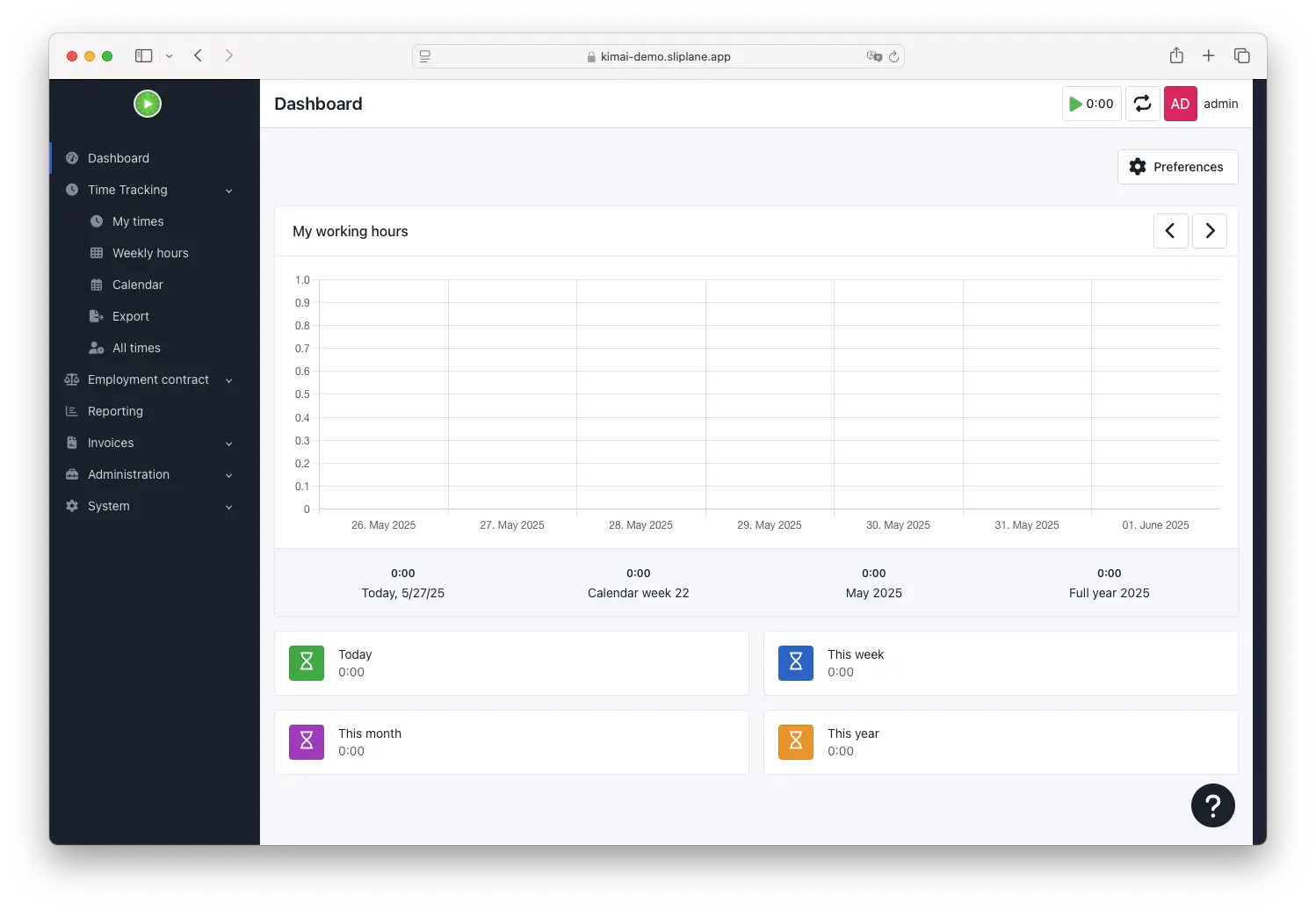
Setup
- Signup at sliplane.io, the signup is free and you can use your Github Account to login.
- Create a server: if you just signed up you should already have a trial server that you can use for 48 hours for free. If not, go to > Servers and then click > Create Server
- Create the MySQL service:
- Go to your projects and click > Deploy Service (top right)
- Select "Registry" as the service type
- Use the image
mysql:8.3 - Add the following environment variables:
MYSQL_DATABASE:kimaiMYSQL_USER:kimaiuserMYSQL_PASSWORD:useaverylongandsecurepassword(change this to a secure password)MYSQL_ROOT_PASSWORD:useaverylongandsecurepassword(change this to a secure password)
- Click deploy and wait for the service to be up
- Note down the service name (e.g.,
mysql)
- Create the Kimai service:
- Go to your projects and click > Deploy Service (top right)
- Select "Registry" as the service type
- Use the image
kimai/kimai2:apache - Add the following environment variables:
ADMINMAIL: Your admin emailADMINPASS: Your admin passwordDATABASE_URL:mysql://kimaiuser:useaverylongandsecurepassword@mysql-1/kimai?charset=utf8mb4&serverVersion=8.3.0(make sure the variables match the ones you used for the MySQL service)
- Click deploy and wait for the service to be up
- Open the domain provided by sliplane (you can find it in the service settings, it should be
service-name.sliplane.app) - Follow the setup steps in the Kimai dashboard and you're done!
Comparison to other Hosting platforms
Of course you can also self-host Kimai with other cloud providers. Here is a pricing comparison for the most common ones:
| Provider | vCPU | RAM | Disk | Monthly Cost | Note |
|---|---|---|---|---|---|
| Sliplane | 2 | 2 GB | 50 GB | €22.80 | Flat rate, free egress, SSL included |
| Fly.io | 2 | 2 GB | 40 GB | ~$17.83 | Disk and bandwidth billed separately |
| Render | 1 | 2 GB | 40 GB | ~$35 | 5 GB bandwidth included on Hobby; disk billed separately |
| Railway | 2 | 2 GB | 40 GB | Up to ~$66 | Usage-based; Pro required for a 40 GB volume |
Click here to see how these numbers were calculated.
Prices checked July 19, 2026. Assuming an always-on instance running 730 hrs/month, Germany/Amsterdam where regional pricing applies, excluding VAT and egress.
- Sliplane: Base server with 2 vCPU, 2 GB RAM and 20 GB storage = €17.80/month; the 50 GB storage tier adds €5 -> €22.80/month. Unlimited services, free egress and SSL are included.
- Fly.io: in Amsterdam,
shared-cpu-2xwith 2 GB RAM = $11.83/month + 40 GB volume × $0.15/GB = $6 -> ~$17.83/month. Egress is billed separately at $0.02/GB in Europe. - Render: closest match is Standard ($25, 1 vCPU / 2 GB) plus 40 GB disk × $0.25/GB = $10 -> ~$35/month. A Hobby workspace includes 5 GB bandwidth, then charges $0.15/GB. Stepping up to Pro compute (2 vCPU / 4 GB) costs $85/month plus disk.
- Railway (Pro plan): at full resource usage: CPU 2 × $20/vCPU/month = $40; RAM 2 × $10/GB/month = $20; volume 40 × $0.15/GB/month = $6 -> up to ~$66/month. Actual CPU and RAM charges depend on usage. A 40 GB volume requires Pro; its $20/month subscription is a minimum commitment that counts toward usage, not an additional charge. Egress is $0.05/GB.
Bandwidth costs can add up fast on usage-based providers. Use our bandwidth cost comparison tool to see what your egress would cost on each platform.
Move the slider or play the animation to compare monthly egress costs. Sliplane stays free as traffic grows.
Egress only, excluding compute and storage. Based on public US/European rates checked July 19, 2026. Render includes its first 5 GB per month. Sliplane egress is free, subject to the Fair Use Policy.
FAQ
You got questions? We got answers!
Is self-hosted Kimai the same as the official Kimai?
Yes! The self-hosted version includes all features of Kimai, including:
- Multi-user Support with role-based access control
- Project Management and customer organization
- Invoicing capabilities
- Detailed reporting and data export
- API Access for integrations
- Mobile-friendly interface
- Plugin system for extending functionality
Are there any usage based costs with sliplane?
Compute is always a flat, fixed price. The first 2 Terrabytes of bandwidth are free, afterwards you pay 2 euros/TB per month (14.8 in singapore)
How do I update the Kimai version?
If you used the latest tag, you can simply redeploy the service (there is a button on the dashboard for that). If you used a specific version, you can update it by changing the image tag in the Sliplane settings and redeploying the service.
What about security?
Sliplane handles the security basics for you:
- Automatic SSL/TLS certificates
- Regular security updates
- Daily backups
- 24/7 monitoring
- DDoS protection
You should still:
- Enable 2FA in Kimai
- Use strong passwords
- Regularly review user access